Founder Talk: Mr. Vikas Chadda of ProcUrPal in Conversation with Radhika Bansal

Radhika: Welcome, Mr. Chadda. It’s a pleasure to have you here today. Let’s start with what inspired you to start ProcUrPal, and can you share the story behind its inception? Vikas Chadda: Thank you for having me. The inspiration for ProcUrPal stemmed from my extensive experience in the IT infrastructure and SaaS industries, working with global organizations like Lenovo, Xerox, Sify, and Reliance. Throughout my career, particularly during my stints managing Government/Public Sector, Global, and Enterprise customers, I had the privilege of handling large, complex RFPs and eAuctions. These experiences revealed a critical need for a more streamlined, transparent approach to procurement processes. We aimed to bridge the gaps I observed during my time in these industries and offer a platform that drives true value for our clients. Equally significant was the expertise brought in by Subramanya Nagaraj, who has three decades of experience in the procurement domain. Together, we saw an opportunity to harness AI and advanced analytics to create a solution that could transform procurement, making it more efficient, transparent, and cost-effective. This vision led to the birth of ProcUrPal. Our goal was to revolutionize procurement through innovative technology, addressing the pain points that we had witnessed firsthand and creating a platform that adds substantial value to businesses by optimizing their procurement processes. Thus, ProcUrPal was born, driven by a vision to revolutionize procurement through innovative technology. Radhika: ProcUrPal has recently received significant recognition, including the ‘Innovative Leaders of The Year 2024 Award’ by Business Connect Magazine and the ‘Best Use of AI in Procurement & SaaS’ award at the India AI Summit. Can you share what these accolades mean for your company and how they reflect ProcUrPal’s approach to innovation in the procurement space? Vikas Chadda: These accolades are incredibly meaningful for us at ProcUrPal. Being named ‘Innovative Leaders of The Year 2024’ by Business Connect Magazine and receiving the ‘Best Use of AI in Procurement & SaaS’ at the Elets India AI Summit is both humbling and motivating. These awards reflect our relentless commitment to pushing the boundaries of what’s possible in procurement. At ProcUrPal, we believe that innovation isn’t just about adopting the latest technologies—it’s about understanding the challenges our customers face and finding creative, effective solutions that make a real impact.   Radhika: What sets ProcUrPal apart from other procurement solutions, and how do you ensure it consistently adds value to your clients? Vikas Chadda: ProcUrPal stands out due to several key factors. First and foremost, we are proudly made in India for the world. This means we deeply understand the complexities and nuances of Indian businesses, which gives us a unique edge. Unlike many global ERP players who often struggle to adapt to the diverse and intricate requirements of Indian enterprises, we have designed ProcUrPal to seamlessly address these challenges. Our platform leverages AI and advanced analytics to automate procurement processes and provide actionable insights. This AI-driven approach not only streamlines operations but also helps in making data-driven decisions, significantly enhancing efficiency and transparency. Furthermore, ProcUrPal integrates effortlessly with existing systems, ensuring a smooth transition for our clients. We are committed to continuous improvement, driven by regular customer feedback, which allows us to stay ahead of the curve and consistently add value. Radhika: What were some significant challenges you faced while establishing ProcUrPal, and could you share a moment that made you realize the impact of your platform? Vikas Chadda: Leaving a secure corporate job to start my own venture was a significant leap of faith. The journey of establishing ProcUrPal came with its fair share of challenges, starting from the ground up. The first step was validating the idea—ensuring that our solution addressed a real pain point in the procurement industry. This involved extensive market research and countless discussions with potential users / CPOs to refine our concept. Once we validated the idea, the next challenge was achieving product-market fit. We had to ensure that our platform met the specific needs of our target audience, which required iterative development and feedback loops. Developing a robust product required meticulous planning and execution, ensuring that our platform was scalable, secure, and user-friendly. As a bootstrapped organization, managing funds for continuous development was particularly challenging. We had to be very strategic and efficient with our resources to keep the momentum going. Radhika: What trends do you foresee in the procurement industry, and what is your vision for ProcUrPal in the next five to ten years? Vikas Chadda: The procurement industry is rapidly evolving, with a strong emphasis on digital transformation and sustainability. I foresee increased adoption of AI to enhance efficiency and transparency. Supplier diversity and ethical sourcing will also become more prominent. For ProcUrPal, our vision is to be at the forefront of these trends, continuously innovating to meet the changing needs of our clients. In the next five to ten years, I see ProcUrPal expanding its global footprint, offering comprehensive procurement solutions that drive sustainable value for businesses worldwide. Radhika: As ProcUrPal expands its global footprint, how do you plan to offer comprehensive procurement solutions that drive sustainable value for businesses worldwide? Vikas Chadda: Expanding ProcUrPal’s global footprint is an exciting and strategic phase for us. Our approach to offering comprehensive procurement solutions that drive sustainable value for businesses worldwide involves several key initiatives. Firstly, we are committed to localizing our platform to meet the specific needs and regulatory requirements of different regions. This means adapting our solutions to address the unique challenges and opportunities present in various markets. By understanding local business practices and regulatory environments, we can provide more relevant and effective procurement solutions. Secondly, we leverage our AI and analytics capabilities to offer tailored insights and recommendations that drive efficiency and cost savings. Our platform’s ability to analyze vast amounts of data and generate actionable insights helps businesses make informed procurement decisions, reduce waste, and optimize their supply chains. Sustainability is at the core of our strategy. We are incorporating features that promote ethical sourcing and supplier diversity, as well as tools to help businesses measure and reduce their carbon footprint.

⁠Manual RFx vs Automated RFx: Cost, Risk, and Time Comparison

Manual RFx vs Automated RFx: Cost, Risk, and Time Comparison RFx execution is one of the most resource-intensive activities in procurement. While many organisations still rely on manual, spreadsheet-driven RFx processes, rising volumes, compliance pressure, and stakeholder expectations are exposing their limitations. Comparing manual RFx with automated RFx clearly shows why modern procurement teams are moving toward automation. Platforms like ProcUrPal are designed to address these exact gaps. Cost Comparison: Hidden Effort vs Measurable Efficiency Manual RFx: High Hidden Costs Manual RFx relies heavily on buyer time—creating documents, managing emails, consolidating responses, and preparing evaluations. These costs rarely appear on balance sheets but accumulate rapidly through rework, delays, and errors. Supplier follow-ups, clarification tracking, and manual reporting further inflate operational cost. Automated RFx: Lower Cost per Event Automated RFx platforms reuse templates, supplier data, and evaluation frameworks. Tasks that once took days are completed in hours, reducing cost per event. Over time, automation significantly lowers procurement operating costs without increasing headcount. Risk Comparison: Informal Control vs Built-In Governance Manual RFx: High Risk Exposure Manual processes increase risk due to inconsistent templates, undocumented changes, scattered communication, and missing audit trails. Approval bypasses, evaluation bias, and poor documentation often surface only during audits—when it’s too late. Automated RFx: Governance by Design Automated RFx enforces standardized templates, role-based access, mandatory approvals, and immutable audit logs. All actions are time-stamped and traceable, dramatically reducing compliance, financial, and reputational risk. Time Comparison: Linear Execution vs Parallel Speed Manual RFx: Slow and Sequential RFx stages—creation, publishing, clarification, evaluation, and approval—happen sequentially. Dependencies on individuals slow progress, and delays compound with every handoff. Cycle times stretch unpredictably. Automated RFx: Faster, Parallel Execution Automation enables parallel evaluations, real-time clarifications, automated reminders, and instant reporting. RFx cycle times shrink significantly, allowing procurement to respond faster to business needs. Supplier Experience: Friction vs Engagement Manual RFx often frustrates suppliers with unclear documents, email confusion, and inconsistent instructions—leading to low participation. Automated RFx provides structured, intuitive supplier interfaces, centralized communication, and transparency—driving higher response rates and better competition. Visibility & Insights: After-the-Fact vs Real-Time Manual RFx offers limited visibility, relying on static reports created after events close. Automated RFx delivers real-time dashboards showing event status, participation, savings, and risks—enabling proactive management instead of reactive correction. Side-by-Side Summary Dimension Manual RFx Automated RFx Cost High hidden effort Lower cost per event Risk High, unmanaged Built-in governance Time Slow, sequential Fast, parallel Supplier Participation Inconsistent Higher and measurable Visibility Retrospective Real-time How ProcUrPal Accelerates the Shift to Automated RFx ProcUrPal enables organisations to: Standardize and automate RFx workflows Reduce cycle times without increasing headcount Strengthen compliance and audit readiness Improve supplier participation and outcomes Gain real-time analytics and control The result is sourcing that is faster, safer, and more cost-effective. Final Thought Manual RFx may feel familiar, but it comes with escalating cost, risk, and delay. Automated RFx replaces inefficiency with intelligence—allowing procurement teams to scale, comply, and deliver value with confidence. In today’s enterprise environment, automation is no longer optional—it’s foundational. ProcUrPal.in is an award-winning, ISO 27001-certified AI procurement platform built to support 🇮🇳 𝗠𝗮𝗸𝗲 𝗶𝗻 𝗜𝗻𝗱𝗶𝗮 vision through digital procurement transformation. If your organization is exploring digital procurement transformation please explore our demo videos https://procurpal.in/demo-videos/

⁠Single-Bid RFx: Risks, Compliance Issues, and Best Practices

Single-Bid RFx: Risks, Compliance Issues, and Best Practices Single-bid RFx events—where only one supplier submits a response—are sometimes unavoidable. However, they carry heightened risk and attract increased scrutiny from auditors, regulators, and leadership. Without strong governance, single-bid sourcing can expose organisations to compliance failures, inflated costs, and reputational damage. Procurement platforms like ProcUrPal help organisations manage these scenarios transparently and defensibly. Why Single-Bid RFx Events Occur Single-bid situations typically arise due to: Highly specialised or proprietary requirements Limited supplier markets or monopolies Urgent or emergency procurement Poor RFx design or insufficient supplier outreach Understanding the root cause is critical before proceeding. Key Risks of Single-Bid RFx Single-bid sourcing significantly increases: Pricing risk, due to lack of competitive pressure Compliance risk, especially in regulated industries Audit risk, as justification and documentation are scrutinised Reputational risk, from perceived lack of fairness or transparency Without mitigation, these risks can outweigh the convenience of moving forward. Compliance & Audit Concerns Auditors and regulators often expect: Clear justification for single-bid events Evidence of adequate supplier outreach Documented approvals and exceptions Proof that pricing is fair and reasonable Failure to demonstrate these controls can result in audit findings or policy violations. Best Practices to Manage Single-Bid RFx Events 1. Mandate Formal Justification Require documented business justification explaining why competitive bids were not feasible. This should be reviewed and approved before award. 2. Strengthen Market & Price Validation Use benchmarks, historical pricing, or third-party data to validate price reasonableness in the absence of competition. 3. Enforce Higher Approval Thresholds Single-bid awards should trigger enhanced approvals from senior stakeholders or procurement leadership. 4. Ensure Full Documentation & Traceability Capture RFx details, communication history, evaluations, and approvals in a single system to ensure audit readiness. 5. Review & Improve Future Sourcing Strategy Analyse single-bid events to identify whether better supplier discovery, RFx design, or timelines could improve future competition. How ProcUrPal Supports Single-Bid Governance ProcUrPal helps organisations manage single-bid RFx scenarios by: Flagging single-bid events automatically Enforcing justification and approval workflows Capturing complete audit trails and communications Providing analytics to monitor single-bid frequency This ensures single-bid sourcing is controlled, transparent, and defensible. Final Takeaway Single-bid RFx events are not inherently wrong—but they demand strong governance and discipline. By applying clear controls, documenting decisions, and using data to validate outcomes, procurement teams can manage risk while maintaining speed and compliance. In procurement, transparency is the strongest defense. ProcUrPal.in is an award-winning, ISO 27001-certified AI procurement platform built to support 🇮🇳 𝗠𝗮𝗸𝗲 𝗶𝗻 𝗜𝗻𝗱𝗶𝗮 vision through digital procurement transformation. If your organization is exploring digital procurement transformation please explore our demo videos https://procurpal.in/demo-videos/

⁠Reducing Procurement Risk Through Better RFx Governance

Reducing Procurement Risk Through Better RFx Governance Procurement risk rarely comes from a single bad decision—it builds quietly through inconsistent processes, poor documentation, weak controls, and fragmented communication. RFx events sit at the center of this risk landscape. Without strong RFx governance, organisations expose themselves to compliance failures, financial leakage, supplier disputes, and audit challenges. This is where structured platforms like ProcUrPal play a critical role by embedding governance directly into sourcing workflows. Understanding Procurement Risk in RFx RFx-related risks commonly include: Non-compliant sourcing practices Inconsistent evaluation criteria Unapproved scope or commercial changes Lack of audit trails and documentation Supplier disputes due to unclear communication Governance is not about control for its own sake—it is about protecting the organisation while enabling fair and effective sourcing. Standardized RFx Structures Reduce Exposure One of the biggest risk drivers is inconsistency. Standardized RFx templates ensure that every event includes: Approved legal and commercial clauses Clear scope definitions and timelines Mandatory compliance and eligibility criteria This reduces ambiguity and ensures every RFx meets organisational and regulatory requirements. Controlled Approvals & Role-Based Access Strong RFx governance enforces who can do what, and when. Key controls include: Role-based permissions for creators, evaluators, and approvers Mandatory approval checkpoints before publishing or awarding Separation of duties to prevent conflict of interest These controls prevent unauthorized changes and strengthen accountability. Transparent & Defensible Evaluations Poorly governed evaluations are a major source of disputes. Effective governance ensures: Pre-defined evaluation criteria and weightings Structured scoring frameworks Recorded evaluator comments and justifications This creates defensible sourcing decisions that stand up to internal and external scrutiny. Centralized Communication Minimizes Disputes When supplier communication is scattered across emails, context is lost and risk increases. Centralized RFx communication: Keeps all clarifications and negotiations in one place Ensures equal information sharing across suppliers Provides a complete, time-stamped record This transparency significantly reduces dispute risk. Audit-Ready Documentation & Traceability Audits often fail not because processes were wrong—but because evidence is missing. Strong RFx governance ensures: Automatic audit logs of every action Documented approvals, changes, and decisions Easy retrieval of RFx records and communications This makes audits faster, smoother, and less disruptive. Continuous Risk Monitoring Through Analytics Governance should be proactive, not reactive. Analytics help identify: Deviations from standard RFx processes Unusual approval overrides Low competition or supplier participation risks Early visibility allows corrective action before risks escalate. How ProcUrPal Strengthens RFx Governance ProcUrPal embeds governance across the RFx lifecycle through: Standardized, centrally managed templates Automated approval workflows In-platform collaboration and communication Immutable audit trails and real-time analytics This ensures compliance without sacrificing speed or flexibility. Final Perspective Reducing procurement risk is not about slowing sourcing down—it’s about making every RFx defensible, transparent, and controlled. With strong RFx governance in place, procurement teams can move faster with confidence, knowing risk is managed by design, not by exception. ProcUrPal.in is an award-winning, ISO 27001-certified AI procurement platform built to support 🇮🇳 𝗠𝗮𝗸𝗲 𝗶𝗻 𝗜𝗻𝗱𝗶𝗮 vision through digital procurement transformation. If your organization is exploring digital procurement transformation please explore our demo videos https://procurpal.in/demo-videos/

Key Questions to Ask Before Choosing an RFx or Sourcing Platform

Key Questions to Ask Before Choosing an RFx or Sourcing Platform Selecting an RFx or sourcing platform is a strategic decision that shapes how procurement operates for years. The right platform accelerates sourcing, improves compliance, and delivers measurable value. The wrong one creates friction, low adoption, and hidden costs. Before committing, procurement leaders should ask the right questions—beyond feature lists and demos. Platforms like ProcUrPal are built around these critical considerations. 1. Does the Platform Support All RFx Types End-to-End? A robust sourcing platform should seamlessly support RFI, RFP, and RFQ—not as separate tools, but as connected stages of a single sourcing lifecycle. Key considerations: Can teams move from RFI to RFP or RFQ without rework? Are templates and supplier data reusable across events? Is governance consistent across all RFx types? 2. How Easy Is It for Suppliers to Participate? Supplier experience directly impacts participation and competition. Ask: Is the supplier interface intuitive and easy to adopt? Can suppliers respond without extensive training? Are clarifications and document sharing simple and contextual? Low supplier adoption often signals long-term sourcing challenges. 3. Does It Enable Standardization Without Losing Flexibility? Enterprises need consistency—but categories need flexibility. Evaluate: Are RFx templates centrally governed? Can categories customize questions and weightings within limits? Are approvals and audit trails enforced automatically? The goal is control without slowing teams down. 4. How Strong Are Collaboration & Communication Capabilities? RFx success depends on constant collaboration. Ask: Are supplier and internal communications in-platform? Are messages time-stamped and traceable? Can chats be exported for audits or reviews? Fragmented communication leads to lost context and risk. 5. What Analytics and KPIs Are Available Out of the Box? Visibility separates operational tools from strategic platforms. Key questions: Does the platform track supplier participation and response quality? Can you measure cycle times, savings, and value realization? Are dashboards real-time and role-based? Without analytics, improvement is guesswork. 6. Is the Platform Integrated with Downstream Procurement Processes? Sourcing does not end with supplier selection. Check: Does RFx link to contracts, POs, and invoices? Can expected savings be tracked through execution? Is data reused, or re-entered manually? Disconnected systems cause value leakage. 7. How Scalable Is the Platform? Your sourcing needs will grow. Ask: Can the platform handle higher RFx volumes? Does performance remain stable as users and suppliers increase? Is licensing flexible and transparent? Scalability protects your long-term investment. 8. How Does AI Actually Add Value? AI should solve real problems—not just sound impressive. Evaluate: Does AI improve evaluations, insights, or savings tracking? Is AI explainable and auditable? Does it reduce manual effort measurably? Practical AI matters more than buzzwords. 9. How Strong Are Security, Compliance & Audit Controls? Procurement data is sensitive and regulated. Ask: Are role-based access and approvals enforced? Are audit logs comprehensive and immutable? Does the platform meet enterprise security standards? Trust and governance are non-negotiable. 10. Will Users Actually Adopt It? The best platform fails without adoption. Consider: Is the UI intuitive for buyers and stakeholders? How steep is the learning curve? Does the platform reduce effort or add steps? Adoption determines ROI. Final Takeaway Choosing an RFx or sourcing platform is not about features—it’s about fit, scalability, and value realization. Asking the right questions upfront ensures procurement selects a platform that supports today’s needs and tomorrow’s ambitions. The right choice turns sourcing into a strategic advantage—not just a process. ProcUrPal.in is an award-winning, ISO 27001-certified AI procurement platform built to support 🇮🇳 𝗠𝗮𝗸𝗲 𝗶𝗻 𝗜𝗻𝗱𝗶𝗮 vision through digital procurement transformation. If your organization is exploring digital procurement transformation please explore our demo videos https://procurpal.in/demo-videos/

How Enterprises Can Scale RFx

How Enterprises Can Scale RFx Without Scaling Headcount As enterprises grow, procurement demand grows with them. More business units, more categories, more suppliers—and inevitably, more RFx events. Yet most organisations face the same constraint: headcount cannot scale at the same pace. The challenge for procurement leaders is clear—how to increase RFx volume, speed, and quality without burning out teams. The answer lies in process standardisation, intelligent automation, and data-driven execution, enabled by platforms like ProcUrPal. The Traditional RFx Scaling Problem In many enterprises, RFx execution is still heavily manual: Custom documents created for every event Repetitive supplier onboarding and communication Spreadsheet-based evaluations Manual follow-ups and approvals As RFx volume increases, these inefficiencies compound—leading to delays, errors, and team fatigue. 1. Standardize RFx Templates and Workflows Scaling starts with repeatability. Standard RFx templates allow teams to launch events quickly without reinventing the process. Best practices include: Pre-approved RFI, RFP, and RFQ templates Category-specific question libraries Standard evaluation criteria and scoring models Standardisation reduces setup time while ensuring governance and consistency. 2. Automate Supplier Engagement and Communication Manual supplier follow-ups consume significant time. Automation removes this burden. Enterprises should: Automate RFx invitations and reminders Centralize clarifications and Q&A Enable real-time, in-platform communication This ensures suppliers stay engaged without constant manual intervention. 3. Enable Parallel Evaluations and Approvals Sequential reviews slow down RFx cycles. Scalable procurement enables parallel collaboration. Key enablers: Role-based access for evaluators Simultaneous technical and commercial evaluations Automated approval workflows This significantly reduces cycle time per event. 4. Use Analytics to Focus Effort Where It Matters Not all RFx events require the same level of effort. Analytics help teams prioritise. Procurement leaders should track: Event complexity vs value Supplier participation rates Historical savings outcomes This allows teams to allocate effort strategically rather than evenly. 5. Integrate RFx with Downstream P2P Processes Scaling RFx without integration creates downstream chaos. Linking sourcing to contracts, POs, and invoices ensures that effort translates into value. Integrated workflows: Reduce rework and data duplication Improve savings realization Strengthen audit readiness How ProcUrPal Enables RFx at Scale ProcUrPal supports high-volume, high-quality RFx execution by: Centralized template and supplier management Automated workflows and approvals AI-assisted evaluations and insights Real-time dashboards and performance tracking The result is more RFx events, faster cycles, better outcomes—without more people. Final Thought Scaling RFx is not about asking teams to work harder—it’s about enabling them to work smarter. With the right technology and governance, enterprises can meet growing sourcing demands while keeping procurement lean, effective, and strategic.   ProcUrPal.in is an award-winning, ISO 27001-certified AI procurement platform built to support 🇮🇳 𝗠𝗮𝗸𝗲 𝗶𝗻 𝗜𝗻𝗱𝗶𝗮 vision through digital procurement transformation. If your organization is exploring digital procurement transformation please explore our demo videos https://procurpal.in/demo-videos/

Expected vs Realized Savings: Why Procurement Needs Better Analytics

Expected vs Realized Savings: Why Procurement Needs Better Analytics Savings sit at the center of procurement’s value narrative. Yet for many organisations, there is a persistent and frustrating gap between expected savings—those projected during sourcing—and realized savings, the value that actually reaches the bottom line. Closing this gap is one of the most important challenges facing procurement leaders today. Advanced analytics platforms like ProcUrPal are designed to make this gap visible, measurable, and actionable. What Are Expected Savings? Expected savings are calculated during sourcing events such as RFQs and RFPs. They are typically based on: Benchmark or historical pricing Supplier bids and negotiated rates Volume assumptions and forecasted demand Contracted commercial terms These savings represent procurement intent—what the organisation plans to achieve. What Are Realized Savings? Realized savings reflect what is actually achieved during execution. They depend on: Purchase order compliance Actual consumption volumes Invoice accuracy and matching Contract adherence and price enforcement Without visibility into downstream execution, expected savings remain theoretical. Why the Gap Exists The disconnect between expected and realized savings is rarely due to poor negotiation alone. Common causes include: Maverick buying outside negotiated contracts Volume deviations from forecasts Price mismatches between contracts, POs, and invoices Supplier non-compliance Lack of linkage between sourcing and P2P systems Without integrated analytics, these leakages go unnoticed. Why Traditional Reporting Falls Short Static reports and spreadsheets cannot track savings across the full lifecycle. They fail to: Link sourcing outcomes to POs and invoices Adjust savings based on actual volumes Highlight leakage in real time Provide category or supplier-level insight As a result, procurement struggles to defend its value with confidence. The Role of Advanced Procurement Analytics Better analytics connect RFx → contracts → POs → invoices, creating a single savings narrative. Effective analytics enable: Side-by-side comparison of expected vs realized savings Real-time variance tracking Category-wise and supplier-wise savings analysis Early identification of leakage and non-compliance This turns savings tracking from a retrospective exercise into a proactive control mechanism. How ProcUrPal Helps Close the Savings Gap ProcUrPal delivers savings intelligence by: Capturing expected savings during RFx and negotiations Tracking realized savings through POs and 3-way invoice matching Providing interactive dashboards for variance analysis Highlighting root causes of savings erosion With this visibility, procurement teams can act before value is lost. From Savings Claims to Savings Confidence For procurement leaders, credibility depends on accuracy. When expected and realized savings are aligned, procurement can move from defensive reporting to confident value leadership. Better analytics do more than measure savings—they ensure savings actually happen. ProcUrPal.in is an award-winning, ISO 27001-certified AI procurement platform built to support 🇮🇳 𝗠𝗮𝗸𝗲 𝗶𝗻 𝗜𝗻𝗱𝗶𝗮 vision through digital procurement transformation. If your organization is exploring digital procurement transformation please explore our demo videos https://procurpal.in/demo-videos/

Procurement Dashboards: KPIs That Matter to CPOs

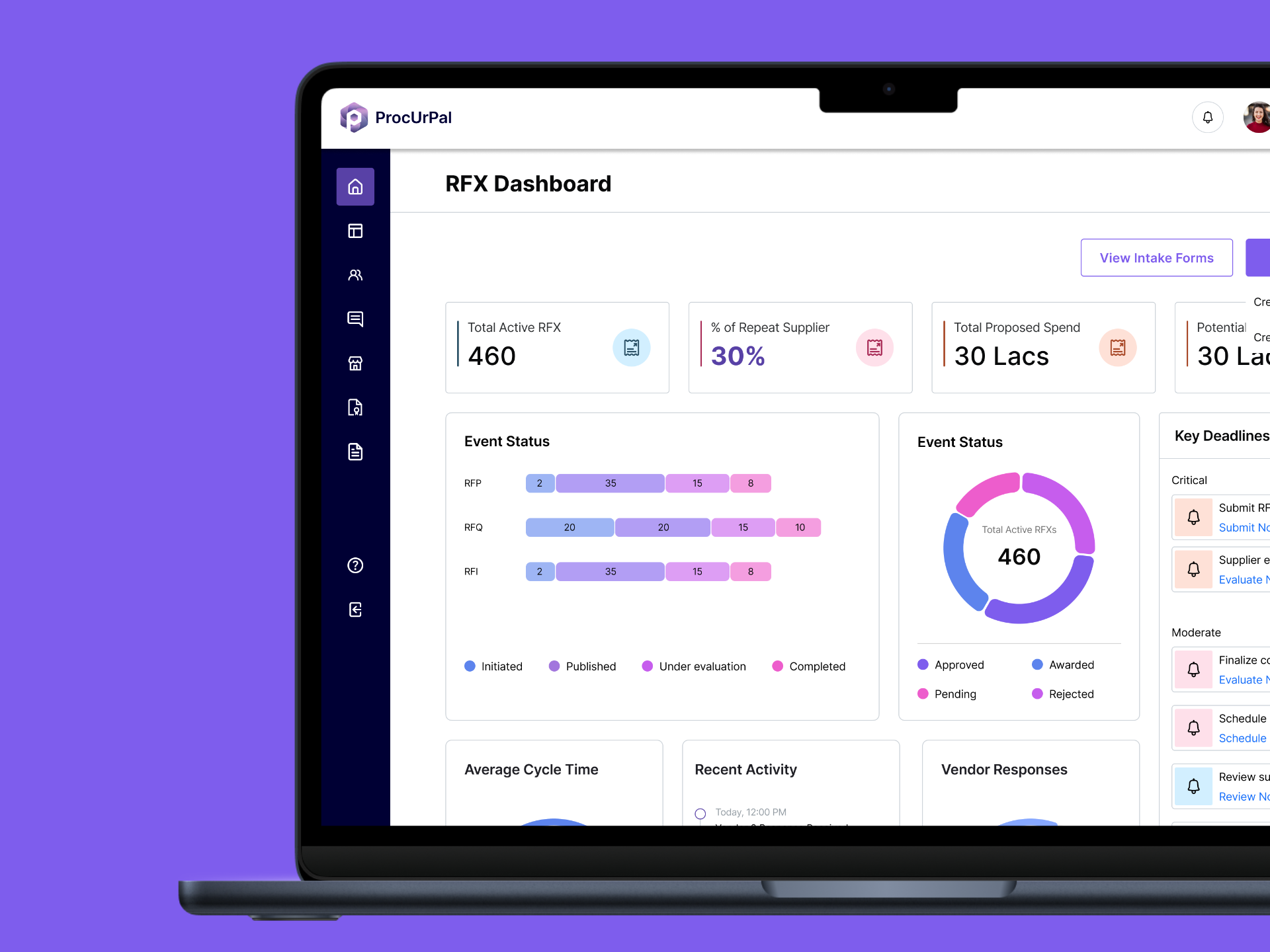
Procurement Dashboards: KPIs That Matter to CPOs For Chief Procurement Officers (CPOs), dashboards are no longer just reporting tools—they are decision engines. In an environment shaped by cost pressure, supply risk, compliance demands, and speed, CPOs need real-time visibility into what truly drives procurement performance. The right KPIs turn data into clarity, and clarity into action. Modern platforms like ProcUrPal are built to surface these metrics in a single, executive-ready view. 1. Spend Visibility & Control KPIs Spend remains the foundation of procurement performance, but visibility is what enables control. Key KPIs CPOs track include: Total spend across categories, business units, and vendors Spend under management vs maverick spend Budget utilisation and variance Top vendors by spend concentration These metrics help CPOs identify leakage, consolidation opportunities, and areas requiring tighter governance. 2. Savings & Value Realisation KPIs Savings are only meaningful when they are measurable and sustainable. Critical KPIs include: Estimated vs realised savings Savings by category and sourcing event Cost avoidance metrics Value contribution beyond price (service levels, risk reduction, innovation) These indicators allow CPOs to demonstrate procurement’s tangible impact on the bottom line. 3. RFx & Sourcing Efficiency KPIs Speed and effectiveness of sourcing are key drivers of business agility. Important RFx KPIs include: Number of RFx events by status (Draft, Live, Under Evaluation, Closed) Average RFx cycle time Supplier participation and response rates Event success rate These metrics highlight process bottlenecks and sourcing maturity across the organisation. 4. Supplier Performance & Risk KPIs CPOs increasingly view suppliers as strategic partners, not just vendors. Dashboards should track: Supplier defect and quality rates On-time delivery and service performance Supplier dependency and risk exposure Compliance and certification status Data-driven supplier insights enable proactive risk management and better sourcing decisions. 5. Contract & Obligation Management KPIs Contracts represent long-term value—and long-term risk if unmanaged. Key KPIs include: Active vs expired contracts Upcoming renewals and expiries Spend against contract vs off-contract spend Contract compliance levels These metrics help CPOs avoid revenue leakage, missed renewals, and operational disruption. 6. Procurement Productivity & Adoption KPIs Efficiency and adoption determine whether procurement systems actually deliver value. Essential KPIs: Events and POs per buyer Approval turnaround times Platform and license utilisation User adoption across business units These indicators show how effectively procurement tools are being used. 7. Governance, Compliance & Audit KPIs Strong governance is non-negotiable for CPOs. Dashboards should provide visibility into: Approval compliance rates Audit trail completeness Exception and override frequency Policy adherence levels These KPIs protect the organisation from regulatory, financial, and reputational risk. How ProcUrPal Delivers Executive-Ready Dashboards ProcUrPal brings all these KPIs together through: Real-time, role-based dashboards Drill-down views from summary to transaction level AI-driven insights and alerts Audit-ready data and traceability This enables CPOs to move from reactive reporting to proactive procurement leadership. Final Takeaway For CPOs, the value of a procurement dashboard lies not in the number of metrics—but in measuring what truly matters. When KPIs align with business outcomes, procurement dashboards become powerful tools for strategy, control, and growth. In a fast-moving procurement landscape, the right insights at the right time make all the difference. ProcUrPal.in is an award-winning, ISO 27001-certified AI procurement platform built to support 🇮🇳 𝗠𝗮𝗸𝗲 𝗶𝗻 𝗜𝗻𝗱𝗶𝗮 vision through digital procurement transformation. If your organization is exploring digital procurement transformation please explore our demo videos https://procurpal.in/demo-videos/

Myths vs Reality: AI in Procurement Automation

Myths vs Reality: AI in Procurement Automation Artificial Intelligence is rapidly reshaping procurement—but it is also surrounded by confusion, hype, and misconceptions. For many leaders, the question is no longer whether to adopt AI, but what it actually does and what it does not. Separating myth from reality is essential to making confident, value-driven decisions. Platforms like ProcUrPal demonstrate how AI delivers practical, measurable impact when applied correctly. Myth 1: AI Will Replace Procurement Professionals Reality: AI augments human expertise—it doesn’t replace it. AI automates repetitive, data-heavy tasks such as data extraction, matching, classification, and analysis. This frees procurement professionals to focus on strategy, supplier relationships, negotiations, and risk management. Decision ownership remains firmly with humans, with AI providing faster insights and recommendations. Myth 2: AI Is Only Useful for Large Enterprises Reality: AI-driven procurement delivers value at every scale. Modern SaaS platforms make AI accessible without heavy infrastructure or long implementation cycles. Mid-sized and growing organisations benefit even more, as AI compensates for limited manpower by automating workflows, improving visibility, and reducing manual errors. Myth 3: AI Procurement Automation Is a “Black Box” Reality: Effective AI in procurement is transparent and explainable. AI does not make hidden decisions—it highlights patterns, flags anomalies, and presents insights backed by data. Whether it’s identifying pricing deviations, low supplier participation, or unusual spend trends, AI supports decisions with clear, auditable logic. Myth 4: AI Only Helps with Cost Savings Reality: Cost is just one part of the value equation. AI also improves: Supplier performance and quality monitoring Cycle time reduction Compliance and audit readiness Demand forecasting and risk identification Contract and renewal management Procurement value extends well beyond negotiated price. Myth 5: AI Requires Perfect Data to Be Effective Reality: AI improves data quality over time. While clean data helps, AI systems are designed to learn from real-world, imperfect datasets. Through continuous usage, AI identifies inconsistencies, standardises information, and improves accuracy—making procurement data more reliable with every cycle. Myth 6: AI Is Only About Automation, Not Intelligence Reality: Automation is just the foundation—insight is the real goal. Beyond automating workflows, AI delivers intelligence by: Analysing supplier behaviour and response trends Highlighting savings leakage Predicting risks and delays Surfacing opportunities for consolidation or renegotiation This turns procurement into a proactive, insight-driven function. How ProcUrPal Applies AI Where It Matters ProcUrPal applies AI across the procurement lifecycle to: Enhance RFx design and evaluation Improve supplier participation and response quality Automate matching and compliance checks Deliver real-time analytics and recommendations The focus is not on flashy features, but on practical automation and actionable insight. Final Perspective AI in procurement is neither magic nor threat—it is a tool. When grounded in real processes and governed by human expertise, AI becomes a powerful enabler of speed, accuracy, and strategic value. For procurement leaders, the real opportunity lies not in believing the myths, but in embracing the reality: AI doesn’t replace procurement—it elevates it.

Best Practices to Increase Supplier Participation in RFx Events

Best Practices to Increase Supplier Participation in RFx Events Low supplier participation is one of the most common—and most costly—challenges in sourcing. When suppliers don’t respond, competition drops, pricing suffers, and procurement loses leverage. For procurement leaders, increasing RFx participation is not about sending more invitations; it’s about creating events suppliers want to respond to. Platforms like ProcUrPal help organisations systematically improve supplier engagement by removing friction, increasing clarity, and building trust. 1. Start with Clear, High-Quality RFx Design Suppliers are far more likely to respond when RFx documents are clear and well-structured. Best practices include: Clearly defined scope and requirements Logical, easy-to-follow sections Clear timelines and evaluation criteria Transparent commercial and compliance expectations Poorly defined RFx events increase supplier effort and risk—often leading to non-participation. 2. Invite the Right Suppliers, Not Just More Suppliers Participation quality matters as much as quantity. Focus on relevant, qualified suppliers rather than mass invitations. Effective strategies: Maintain clean, up-to-date supplier master data Segment suppliers by category, capability, and geography Use past performance and response history to guide invitations Targeted sourcing improves both response rates and bid quality. 3. Reduce Supplier Effort with Simple, Standardized Responses Complex, repetitive RFx formats discourage suppliers—especially SMEs. Standardising questions and response templates significantly lowers entry barriers. Key enablers: Pre-filled supplier profiles Reusable responses across events Clear guidance on mandatory vs optional fields The easier it is to respond, the more likely suppliers are to participate. 4. Enable Two-Way Communication & Clarifications Suppliers disengage when questions go unanswered. RFx platforms should support real-time clarifications and structured Q&A. Best practices: Allow suppliers to ask questions in-context Respond publicly where appropriate to ensure fairness Track response times and communication history Transparent communication builds supplier confidence and trust. 5. Be Transparent About Evaluation & Outcomes Suppliers invest time and resources in RFx responses. When evaluation criteria are unclear—or outcomes are never shared—future participation drops. Increase trust by: Clearly stating evaluation methodology and weightings Sharing feedback where possible Closing events formally and on time Transparency encourages repeat participation. 6. Optimize Timelines and Avoid Last-Minute Changes Unrealistic deadlines and frequent scope changes frustrate suppliers. Respecting supplier time improves engagement. Recommendations: Provide adequate response windows Lock requirements before publishing Communicate changes clearly and promptly Consistency signals professionalism and reliability. 7. Leverage Data to Improve Participation Over Time Participation should be measured and improved continuously. Track: Invitation-to-response ratios Category-wise participation trends Supplier drop-off points Analytics help procurement teams refine sourcing strategies and improve future RFx design. How ProcUrPal Helps Maximize Supplier Participation ProcUrPal enables higher supplier engagement through: Intuitive, supplier-friendly RFx interfaces Centralized communication and clarifications Supplier response and participation analytics Transparent workflows and audit-ready processes By focusing on experience, clarity, and trust, ProcUrPal helps organisations consistently attract stronger supplier participation. Final Thought High supplier participation is not accidental—it’s designed. When RFx events are clear, fair, and easy to engage with, suppliers respond. Procurement teams that invest in supplier experience don’t just get more bids—they get better outcomes.